

There are some reasons why most people delay orthodontic treatment. It could be that they are unsure since they have missing teeth. Another reason could be that their teeth are crowded and are unsure if their teeth can handle something like clear aligners. If this is you, you have no reason to delay. Keep reading to find out more!
So can you use clear aligners for crowded or missing teeth? The short answer is: yes, in many cases. The longer explanation, though, is more nuanced. Understanding how clear aligners work for these specific situations will help you make a much better decision about your treatment.
Let's break it down for you.
What Happens to Your Teeth When You Have Crowding or a Missing Tooth?
Before talking about what clear aligners can and can't do, it helps to understand what's actually happening in your mouth.
Crowded Teeth
Crowded teeth occur when there isn't enough space in the jaw for all teeth to sit in their correct positions. They overlap, rotate, or get pushed forward or backward. Beyond the cosmetic concern, crowding creates areas that are genuinely difficult to clean, such as brackets for plaque, cavities, and gum disease to develop.
Missing Teeth
A missing tooth sets off a different chain of events. Teeth are held in position partly by the pressure of neighbouring teeth on either side. When one is lost, the teeth beside the gap start to drift toward it. The tooth above or below (the opposing tooth) may begin to over-erupt, gradually descending or rising into the empty space. Over time, this shifting changes your bite, creates new crowding, and can accelerate bone loss in the jaw where the root no longer exists to stimulate it.
In other words, a missing tooth is not a static situation. It's an ongoing process. The longer it's left, the more complex the resulting orthodontic picture becomes. This is precisely why early assessment and treatment planning matters so much.
Can Clear Aligners Fix Crowded Teeth?
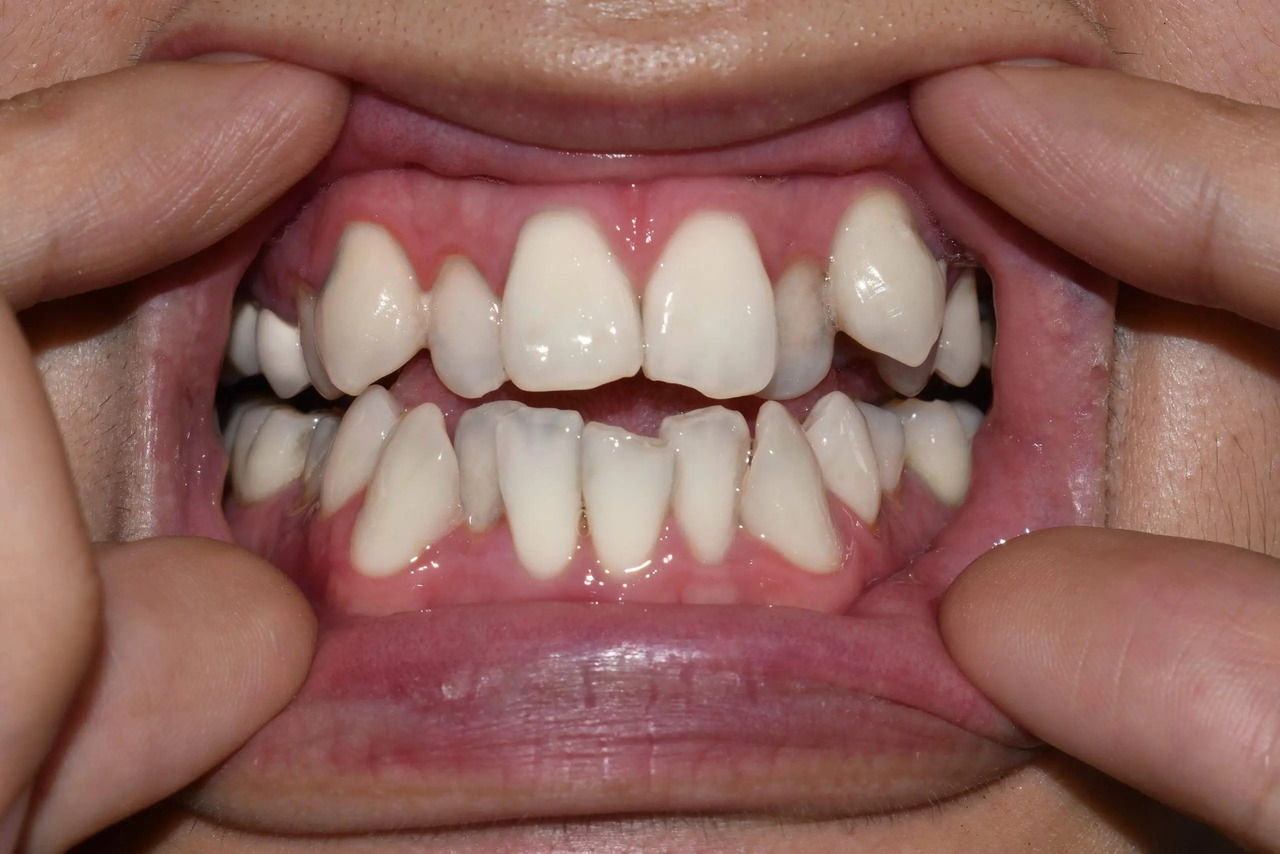
Yes, they can! This is actually one of the areas where clear aligners perform very well. Mild to moderate crowding is among the most common presentations treated with aligners. The digital treatment planning process maps out exactly how much space is needed and which teeth need to move, in which direction, and by how much. Trays are fabricated to execute those movements in sequence, gradually creating alignment without the need for brackets and wires.
Mild Crowding
For mild crowding, treatment can sometimes be completed in as little as six to nine months. Moderate crowding typically takes twelve to eighteen months.
Severe Crowding
Severe crowding is a different matter. When teeth are significantly overlapping, significantly rotated, or when there's a serious bite problem involved, the level of three-dimensional control required may exceed what aligners can reliably deliver. In these cases, traditional braces, or a combination approach, may be more appropriate. Your dentist will be honest with you about this after a proper clinical assessment.
Tooth Extractions for Crowded Teeth
All these aside, there is one important consideration for crowded teeth: tooth extractions. Some crowding cases require one or more teeth to be extracted to create the space needed for proper alignment. This is a clinical decision your dentist makes based on the degree of crowding, your jaw size, and your overall bite. Sometimes, extractions are necessary with both braces and aligner treatment, which is not a reason to avoid either.
Can You Use Clear Aligners If You Have a Missing Tooth?
This surprises many patients, but yes! Clear aligners for missing teeth is a well-established treatment approach. The key is understanding what you want the aligner treatment to achieve in relation to the gap. There are two distinct clinical pathways:
Pathway 1: Close the Gap Permanently
In some cases (particularly when the missing tooth was small, the gap is narrow, or when closing the space produces a better aesthetic and bite outcome) the treatment plan involves using aligners to gradually move neighbouring teeth together to close the gap entirely.
This eliminates the need for a tooth replacement. Once closed, the gap no longer exists, and retainers maintain the result.
Not every gap is suitable for closure. The size of the gap, the teeth on either side, the bite, and the bone available all influence whether this is a viable approach. Your dentist will assess this carefully.
Pathway 2: Straighten Teeth and Preserve or Create Space for an Implant or Bridge
More commonly, when a back molar or prominent tooth is missing and needs to be replaced, the aligner treatment is planned in coordination with the replacement work — whether that's a dental implant, a bridge, or another restoration.
In this scenario, the aligners do two things:
First, they correct any crowding, spacing, or bite issues in the surrounding teeth, straightening everything before the replacement tooth goes in.
Second, they hold (or create) the correct amount of space where the missing tooth will be placed. This is critical: if the gap has already narrowed due to drifting, aligners can re-open it to the correct width before the implant or bridge is fitted.
The digital pontic (a tooth-shaped placeholder in the aligner tray itself) keeps the space looking natural and the tray stable during treatment.
This coordinated approach (orthodontics first, implant or bridge second) produces the best long-term result because the implant is placed into an already-optimised, well-aligned arch.
What About Multiple Missing Teeth?
Multiple missing teeth, or a condition called hypodontia (being born with some teeth absent), can also be treated with clear aligners. Cases like these, though, require careful planning. Even in cases of multiple missing teeth, clear aligners can be used to treat bite issues and alignment problems. Space maintainers can be incorporated into the treatment plan to prevent remaining teeth from drifting into the gaps.
If there are more missing teeth involved, the treatment plan will need to account for how the remaining teeth interact with each other, the bite, and any planned restorations. This is not a case for a template treatment plan. It will need the dentist’s expertise to map out the full picture (orthodontics and restorative work) before starting.
When Clear Aligners May Not Be the Right Choice
Honest dentistry means telling you when something isn't the right fit for you. Clear aligners are not always going to be suitable for every situation involving crowding or missing teeth.
In some cases, you may be directed toward an alternative (or a combined approach) if:
- Your crowding is severe enough that teeth need to be moved in complex three-dimensional ways that exceed aligner capability
- You have active gum disease or significant bone loss which must be treated and stabilised before beginning any orthodontic treatment
- Your missing teeth are creating a compromised bite that requires more control than aligners can provide
- You have multiple missing teeth in a pattern that significantly alters how the remaining teeth function
- You are not yet ready for a replacement tooth and have not had a plan discussed (starting alignment without a restoration plan can create complications)
None of these rules you out of treatment. They mean the treatment plan needs to be more carefully thought through, and possibly involve more than one type of treatment working together.
The Treatment Journey: Clear Aligners + Tooth Replacement at Your Dental Care
For patients who need both orthodontic alignment and a tooth replacement, here is what a coordinated treatment journey typically looks like at Your Dental Care in Sitiawan:
Step 1: Comprehensive Assessment
Your dentist examines your teeth, bite, and gums, and takes X-rays to assess bone levels and the condition of surrounding teeth. This is where the full picture is established: not just the gap, but everything around it.
Step 2: 3D Digital Scan
A digital intraoral scan captures a precise model of your teeth. No messy impressions. The scan data is then used to plan both the orthodontic movements and the position of any future restoration.
Step 3: Integrated Treatment Planning
A treatment plan is designed that sequences the aligner treatment and the tooth replacement correctly. The digital simulation shows you the projected tooth movements at each stage, so you know what to expect throughout.
Step 4: Aligner Treatment
You wear your custom aligner trays as prescribed: 20 to 22 hours per day, progressing through the series. If space is being held for a future implant, a digital pontic keeps the tray fitting naturally over the gap.
Step 5: Tooth Replacement (Implant, Bridge, or Other Restoration)
Once alignment is complete and your teeth are in their correct positions, the replacement tooth is placed into the now well-prepared space. This is the optimal sequence: straight arch first, restoration second.
Step 6: Retainers
Post-treatment retainers maintain your alignment and protect your investment long-term. Your dentist will advise on the right retainer type for your situation.
Frequently Asked Questions
Can I start clear aligner treatment if I already have a dental implant?
Yes, in most cases. Implants are fused to the jawbone and do not move the way natural teeth do, so the aligner treatment plan will need to work around the implant rather than involving it in tooth movement. Your dentist will account for this in the planning stage.
My teeth have shifted because of a missing tooth: can aligners fix that?
Often, yes. If neighbouring teeth have drifted into the gap, aligners can be used to re-position them, either closing the space or restoring the correct gap width for a future implant. The sooner this is addressed, the simpler the correction.
Do I need to replace a missing back molar, or can I leave the gap?
Leaving a gap (even a back molar that's not visible) is generally not recommended long-term. The opposing tooth will begin to over-erupt over time, the adjacent teeth drift, and bone loss begins at the extraction site. Addressing it sooner is always better than later.
How long does combined aligner and implant treatment take?
This varies widely depending on the degree of alignment needed and the implant process. Aligner treatment alone may take six to eighteen months. Dental implants take an additional three to six months for the implant to integrate with the jawbone before the crown is placed. Your dentist will give you a realistic timeline after assessment.
Will the aligner tray cover the gap where my tooth is missing?
Yes it will. The tray is custom-made to cover your entire arch, including the gap. A tooth-shaped pontic (placeholder) is typically incorporated into the tray in the space of the missing tooth, both for aesthetics and to ensure the tray fits and functions correctly.
Is it more expensive to treat crowded teeth alongside a missing tooth?
Treatment involving both alignment and tooth replacement will naturally involve more clinical steps than alignment alone. Your dentist will provide a clear quote covering each stage: orthodontic treatment, any restorative work, and post-treatment retainers, so there are no surprises.
Can children or teenagers with missing teeth due to hypodontia use aligners?
In some cases, yes, depending on the stage of dental development and the specific teeth involved. Aligner brands offer teen-specific versions of their systems. This is a case-by-case decision that your dentist will discuss based on your child's dental development.
Ready to Find Out What's Possible for Your Smile?
Whether you have crowded teeth, a gap from a missing tooth, or both, the right treatment starts with a proper assessment, not a guess.
At Your Dental Care in Sitiawan, we offer both clear aligner treatment and dental implants under one roof. That means we can plan your entire smile journey, alignment and restoration in a coordinated, sequenced way. Don’t need to visit multiple clinics or travel to Ipoh or Kuala Lumpur.
Schedule Your Dental Care for your Loved Ones Today.
Let us take care of your smile in a calm and friendly environment. Appointments can be scheduled easily via WhatsApp through the button below.